
Just a Voyeur
Manning the Dead Zone - X (conclusion)

A conscript from another camp was sent to our outpost for a few weeks to help with manpower. It was the first time I saw someone go to pieces in the army.
I’d seen breakdowns at boot camp—screaming fits, weeping, kids slamming themselves into lockers—but those always blew over. This was quieter and more unsettling. He arrived garrulous and upbeat, then within two weeks sank into a mute, leaden funk. He spent most of his time in his bunk, staring grimly at the mattress above him.
“I can’t take it anymore,” he’d mutter. “All these guns everywhere.”
What finally broke him was a week’s furlough canceled after an officer noticed an empty beer can in the trash. He hadn’t even bothered to bury it. The punishment was routine, but for him it was existential. He’d grown used to the comforts of his previous posting—medic barracks—where he slept uninterrupted and went home four nights a week.
I was surprised to learn our outpost was among the strictest. One conscript nearing the end of his term told me that just a year earlier it was unheard of for anyone to wake up for the two or four am shifts. That changed with the new camp commander.
“Not that I mind,” he said. “We used to just sit around all day, bored as hell, watching TV. At least now there’s something to do.”
As for the gloomy conscript, he was transferred back to the medic barracks before I was discharged. His melancholy lifted as the date neared, like a patient emerging from illness. Despite his misery, no one had any sympathy for him. He’d been exempted from sentry duty, so his sole job was to sit in the living room at night, watch TV, and wake the rest of us for our shifts.
He usually fell asleep.
There were no hot meals on Sundays, but every Sunday evening a woman drove out to our outpost with jumbo containers of roasted chicken, pork, lamb, beans, potatoes, rice—whatever her son’s restaurant had left over after the weekend.
One Sunday evening an inspecting officer arrived while we were digging in.
“Where’d you all get this?” he demanded, peering into the containers.
We explained.
He launched into a sermon about not accepting food from strangers. “There are good people who may bring us food, but there are also people who want to harm us,” he stated soberly, reinforcing Rule #7 under the posted Sentry Guidelines: Trust no one.
We nodded through the lecture with full mouths. He lingered in the kitchen until everyone but me had left, then peered into one of the containers again.
“Is that chicken?”
“Pork,” I said. “Help yourself.”
He nodded, averting his gaze, and reached for a plate.
Officers were at their most creative and inspired when catching conscripts ordering takeaway. One captain intercepted a kebab delivery boy, put on his jacket and helmet, and rode the moped to the outpost, where he doled out punishments along with the kebabs. Another captain, after intercepting the delivery boy, slipped a signed note reading “Five Days Jail” into each wrapper.
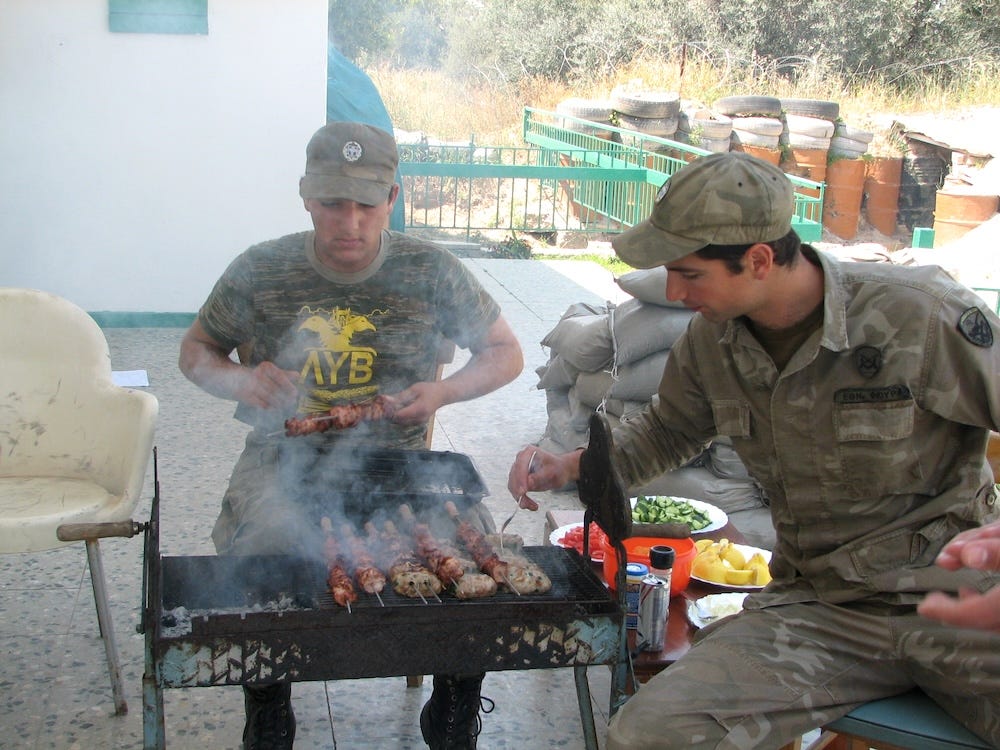
For the most part, ordering food was tolerated. What wasn’t tolerated—at least in my outpost—was ditching sentry duty or, worse, leaving the outpost altogether.
One captain once dressed in black like an old woman and shuffled up to an outpost, stooped and hobbling, to catch a delinquent sentry literally off guard. A few days later, that same conscript left his post to have a drink at a nearby bar. While he was mid-beer, his phone rang, the Caller ID showing the outpost number. He answered. The captain was on the other line.
I once slipped away myself for an hour between shifts to meet a friend at a bar in downtown Nicosia before he left for India. I later learned that if an officer had come by and counted the sleeping bodies, I could have been court-marshalled and given twenty days jail. Even truancy between shifts carried harsher penalties than skipping sentry duty because it reduced manpower, which by extension endangered the outpost and the neighborhood. Of course, war would have to start up—out of nowhere, after decades1 of standstill—for the charge to have any real meaning. But never mind the real world, our job was to perform our roles, theirs was to keep the show running.
All things considered, I had it damn good. I got out two or three times a week. I’d been given a bunk bed in the chief sentry’s room, spared the late-night hooting and the perpetual flicking of lights. No one objected to my bringing in a laptop, and I even had a desk. I ate better than ever, had no expenses, and even received a monthly allowance of seventy pounds2—"whorehouse stipend,” as the conscripts called it.
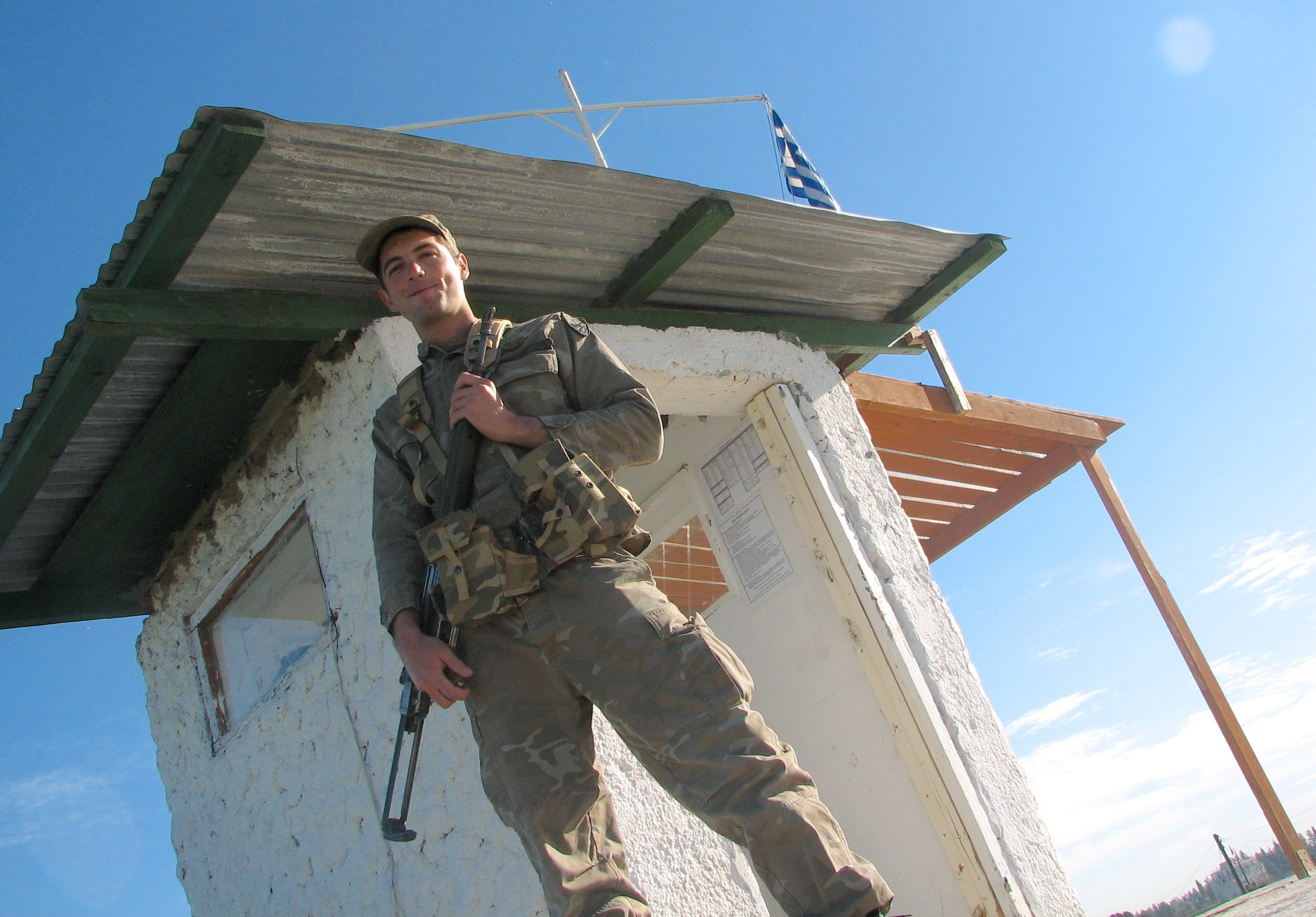
Even sentry duty, tedious as it could be, was really just a period of tech-free solitude in a verdant setting. There are two ways to know the world: by traveling widely or by staying put. I stood sentry for two months at the same two posts, yet the landscape was never the same.
Each hour had its own cast and set: a white crane loping through the late afternoon marshes; an owl studying me from a midnight perch; the call to prayer echoing in surround sound five times a day; the Big Dipper angling above the Turkish spotlight; the sudden roar from the racetrack on Sunday afternoons as gamblers urged their horses on; the distant thud of club music and rotating strobe lights on weekend nights; the peeper frogs performing their matinee at sunset; the morning singing of the Turkish sentry; the Kyrenia mountains snapping into clarity after rain; the olive trees lit up from below by early sun; the bees nesting in the dirt-filled oil drums, emerging in the spring at midday to buzz my head until I swatted one away, which was followed by fleeting guilt as I watched the stunned insect crawl about, recovering, before flying off.
But sentry duty would not have seemed so idyllic had my time not been so brief. The anachronism and stupidity of a two-year conscription3 would have driven me mad, especially given the shambolic day-to-day operations. It was this pervading sense of absurdity that bred cynicism and ennui among the conscripts.
I often wearied of the constant complaints of my housemates, their shrill daily squabbles with the chief sentry over furlough schedules, their torpor, their refusal to do even minimal chores that would have made life easier for everyone. But who was I to judge, with my tidy three-month jaunt? Who was I, when they had to give themselves over for two years—the last of their teen years, when all you want to do is cut loose?
It was all fine and well for me: I’d come into the army at my own initiative, with the zest of an anthropologist heading into the bush. But for the rest of them, their army stint was two senseless years of coercion and servitude. I’d seen what two years could do—not in combat, but in a lower bunk, staring at a mattress, undone by a canceled furlough. Next to them, I was just a voyeur.
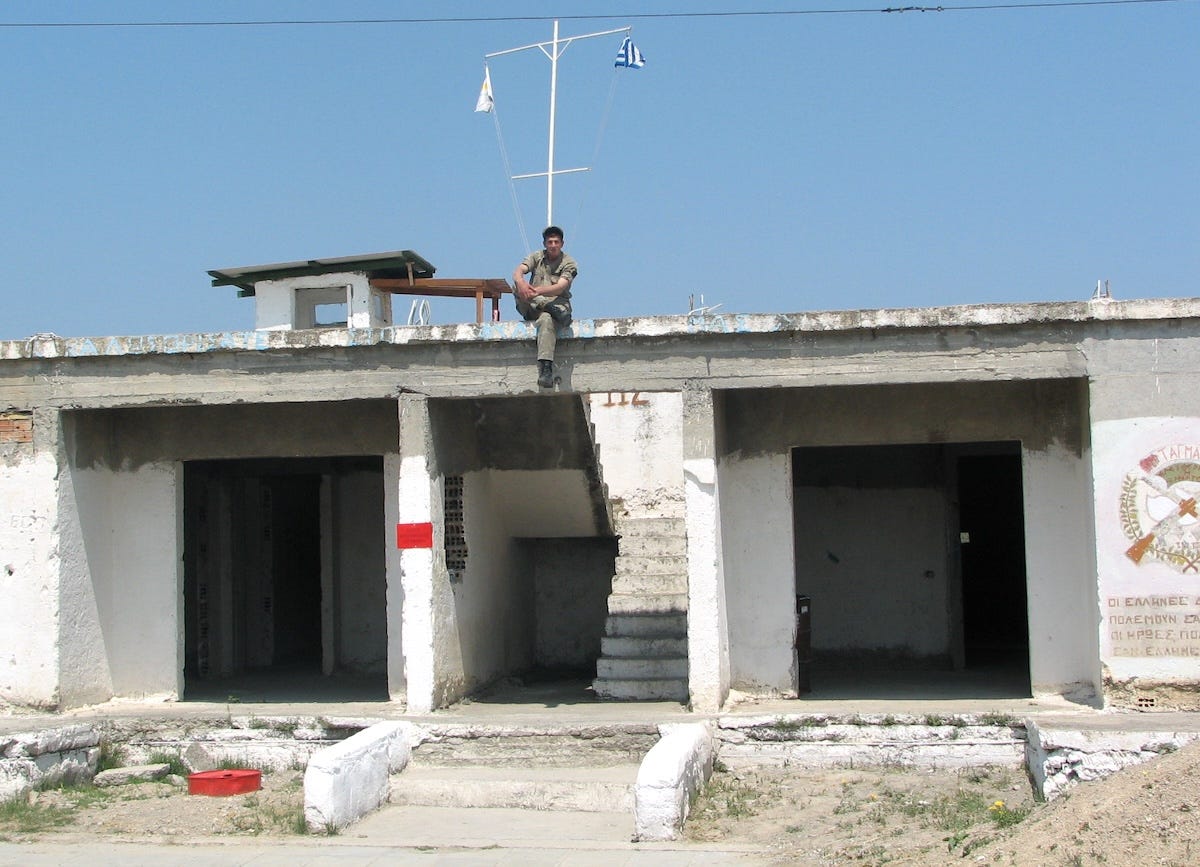
After I’d left, I thought of them often, trudging to and from their posts. Others like them are still there now, pacing, standing, sitting—alert not for Turks but for approaching officers—oblivious to the Dead Zone, waiting for that second hour to pass, counting down the minutes, counting down the months.
THE END
Over five decades now. The Greek coup and subsequent Turkish invasion of Cyprus was in July, 1974.
This was before the island adopted euros. Cyprus entered the Eurozone the next year.
Turns out I wasn’t the only one who felt this way. In 2016, the conscription term was reduced from 24 months to 14.
The army pieces are now finished. Here’s where it all started:

All things must pass, but I will miss reading about your time in the Cypriot army. You have a wonderful way of describing the nonsense often involved in soldiering. Do you ever think the two sides will ever unite? Peace be with you, Constantine, and please continue posting here.
I have thoroughly enjoyed this series, as someone who has always wondered what I would have to "endure" should I ever decide to move to Cyprus (I'm a citizen). I hope you kept a souvenir or two of your time there.