
Make Venezuela Panama Again
(plus my speech before Congress)

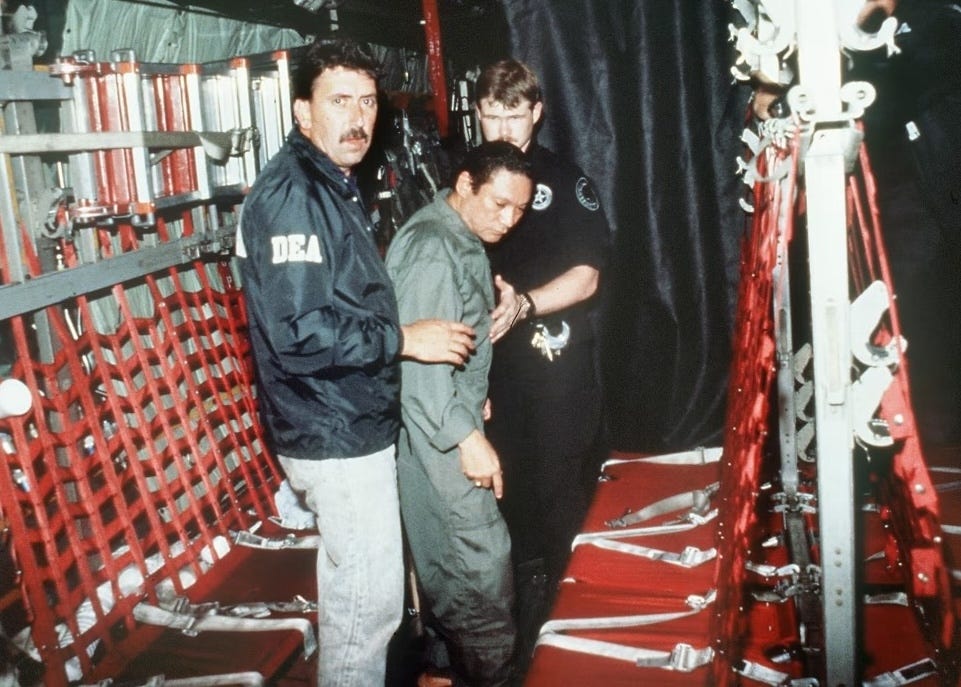
This weekend the U.S. attacked Venezuela and kidnapped its president.
This was a retro foreign policy move, albeit with garish Trumpian garnish. I don’t mean cowboy George Bush retro. I mean CIA George Bush retro. Senior, not Junior. We are back in 1989–1991 territory.
Let me explain.
First, a made-by-TV president ordered a made-for-TV attack. This was a nod to the first TV war, the 1991 Gulf War, when CNN first exploded onto the scene, revolutionizing broadcasting by delivering sensational 24-hour coverage to ensure the public was properly disinformed around the clock. The rest of the media soon followed.
Second, the United States once again spearheaded the overthrow of a Latin American government. This is a longstanding twentieth-century American pastime, but the 1989 invasion of Panama—culminating in the arrest of Manuel Noriega under the pretext of drug trafficking charges—is as close to the bull’s eye as historical analogies get.
And finally, though retro in a broader sense, we watched another regime change for oil. Dispensing with the usual platitudes about freedom and democracy, Trump dropped the smoke screen entirely. He announced that the U.S. would “run the country,” while American energy companies would siphon out the oil.1 That’s as naked and retro as imperial rhetoric gets—kind of like calling the Department of Defense the Department of War again. Naked rhetoric for naked aggression. I respect the symmetry.
The precise mechanics remain unclear. That the Chinook helicopters were able to fly in unmolested suggests collusion, bribery, or some quiet assent within the Venezuelan military. Or to take the unlikeliest but most theatrical scenario, coordination with Maduro. Maybe we’ll learn more. Probably we won’t.
But never mind the tactics, the structure is clear. An ugly global game is underway between two teams—a mashup of Risk, chess, and Squid Games. The tournament has been running for millennia. In this round, Ukraine is a pawn, Syria is a pawn, Venezuela is a pawn. The contestants are consolidating and fortifying their home bases. And it increasingly looks like this latest iteration of the game, just over eighty years old now, may be decided within the next decade or two.
Since we’re firmly back in retro-imperial territory, I thought to share a piece of satire I wrote more than two decades ago after watching the Senate debates leading up to the Iraq War Resolution (this was George W. Bush attempting to follow in his father’s footsteps, unaware he’d soon be swallowed by Gulf quicksand).
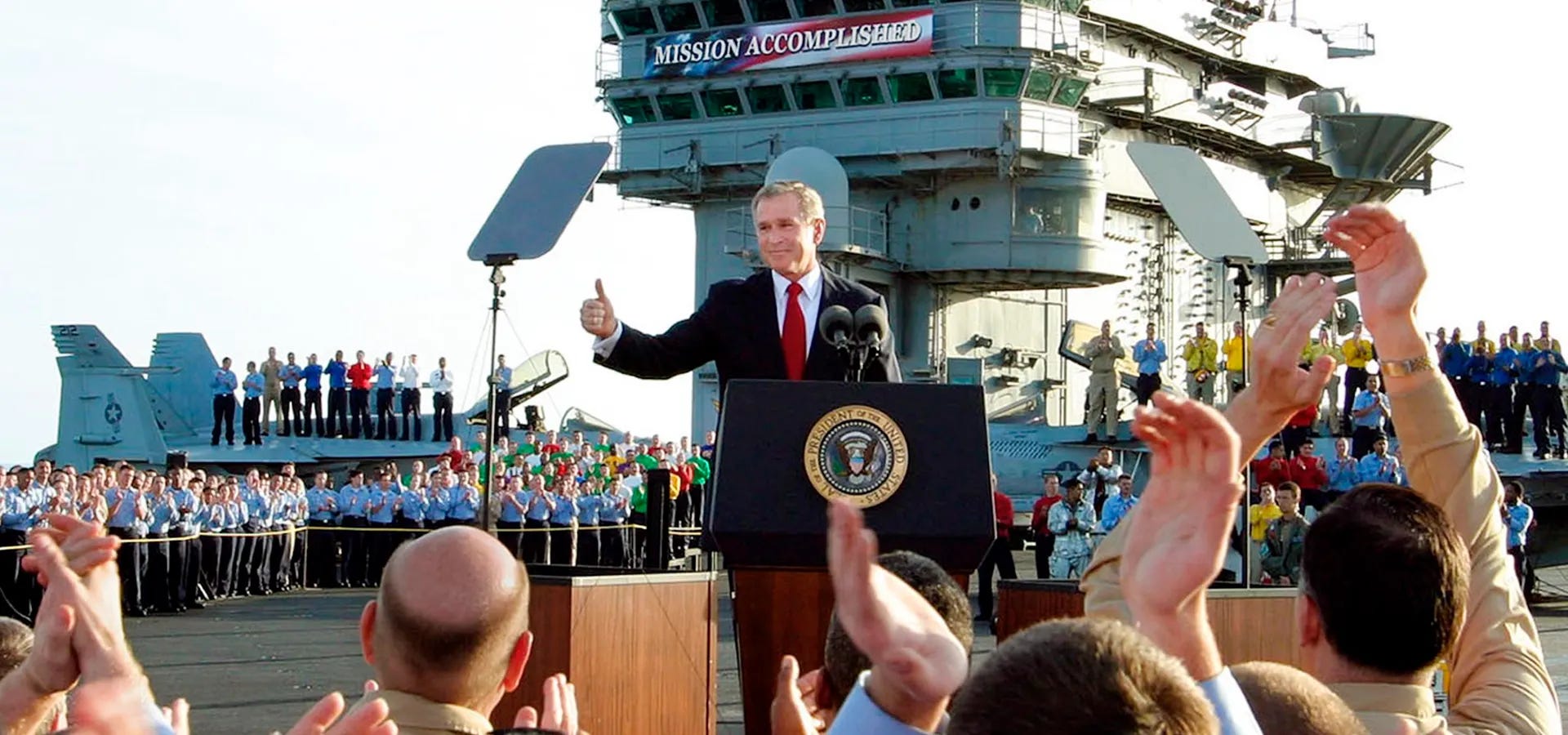
I wrote it as a speech, delivered by a fictional senator, urging Congress to authorize war.
It offers context for this weekend’s “Operation Absolute Resolve”—the official name of the assault on Caracas, which also sounds like satire. When Trump and Hegseth are in charge of naming military operations, parody becomes redundant.
To be fair to G.W. Bush, he at least sought congressional authorization under the War Powers Clause. Trump has no patience for such protocol. He breaks things when he wants and takes what he wants. That’s his style. That’s his privilege. F. Scott Fitzgerald was prescient, because these lines from The Great Gatsby may as well have been written for him:
“They were careless people—Tom and Daisy—they smashed up things and creatures and then retreated back into their money or their vast carelessness, or whatever it was that kept them together, and let other people clean up the mess they had made.”
Trump isn’t alone in bypassing Congress. American presidents usually find a way around this obligation, and our legislators are content to let them. Despite token opposition on the margins, Republicans and Democrats have long functioned as a uniparty pro-war bloc. Their inevitable Yea votes come back to haunt them once the public wearies of their wars. Better, then, that the president acts unilaterally. This way their support isn’t on the record, and later, when reelection season comes around, they can virtue-signal by pretending they were opposed all along.
As you’ll see, I was mainlining Chomsky when I wrote what follows. This was 2002. So for anyone outraged by perceived outrages, misrepresentations, or heresies against Pax Americana, please direct your ire at my younger self. He can handle it. I can too, since for the most part I still agree with him.
I never published the piece at the time. The original ran about 4,000 words—far more than what most would tolerate—so what follows is an abridged version.
I’ve also removed one of the two spaces between sentences (inside joke for Gen Xers).
Consider this a retrieval from the cellar. What you’re about to read is me, over two decades ago, pretending to be a uniparty senator, standing before Congress and arguing why it should authorize the president to wage war in Iraq.
It’s more vinegar than fine wine. But sometimes vinegar is just what’s needed.
October 10, 2002
An Earnest Address by an Undistinguished Congressman to the Speaker of the House in Favor of Letting the President Do to Iraq Whatever He in His Prescience and Magnanimity Sees Fit.
Mr. Speaker, the central issue here is whether Congress should relinquish to one man its constitutional authority to declare war. As Senator Byrd has pointed out, this is a question of constitutional rights, not the Iraqi threat, as is mostly claimed here. While I reject the notion that an Iraqi threat requires us to surrender our congressional power to the President, I nonetheless believe we should do so without hesitation.
First, I am a traditionalist. Why break from time-tested patterns? In the last fifty years, how often has Congress voted against an administration urging war? Often Congress got no chance to vote at all, as in Grenada and Panama or, on a smaller scale, the Bay of Pigs invasion. Such invasions were undertaken by informal presidential order and Congress, at best, was notified. In other instances, Congress handed over war authorization when requested, as in Vietnam and the Gulf War.
In January 1991, five months after Iraq invaded Kuwait, President George H.W. Bush asked Congress for authority to attack Iraq—a cordial gesture after bypassing Congress in sending hundreds of thousands of troops into the region. Flattered by the courtesy, Congress acceded, and with much humanitarian zest, President Bush ordered the offensive that destroyed Iraq’s infrastructure, killed untold numbers of soldiers and civilians, and was followed by over a decade of food and medicine sanctions responsible for more than a million deaths. The President was lauded for these humane acts.
Here we are, in 2002, and President George W. Bush asks Congress for authority to attack Iraq. Mr. Speaker, why should the son be denied the privileges of the father? Why should he be denied the unconstitutional privileges given to all post-World War II presidents? At least he asked.
And, Mr. Speaker, let us not forget our progress. Congress authorized President Johnson to invade Vietnam after North Vietnamese forces had, according to the Secretary of Defense, attacked the U.S. destroyer Turner Joy in the Gulf of Tonkin. This claim later proved fabricated, but it succeeded in prompting the requisite congressional approval and paving the way for the carpet-bombing of Vietnam, Laos, and Cambodia.
This time, no evidence has been presented that Iraq plans to attack the United States, yet we deliberate over war. That is progress. We no longer need to lie or operate on the sly. No more Gulf of Tonkin fabrications or secret Cambodia bombings or tall tales of Iraqi soldiers throwing Kuwaiti babies out of incubators. When no evidence is required, no lying is needed.
Even evidence to the contrary is irrelevant, such as former U.N. weapons inspector Scott Ritter’s testimony that Iraq’s military capacity has been 95 percent dismantled. This is a tremendous achievement.
Mr. Speaker, over these debates we have heard repeatedly that our vulnerability since September 11th must be addressed. I agree wholeheartedly. The population is afraid, and we must maintain that fear. This is a tremendous opportunity.
Vietnam was a blow to future administrations because of the pervasive war-resistance fever. To make matters worse, the Soviet empire collapsed. What a catastrophe! We had always been the superpower, but becoming such an undisputed one gave new grief to the P.R. industry. Anti-war sentiment was bad enough; now we couldn’t even appeal to the looming threat of global communism.
The Reagan Administration valiantly attempted to stir terror about terrorism, with many of the same folk from today’s inner circle—Powell, Rumsfeld, Wolfowitz—and with much the same talk about cleansing the world of an awesome evil that hates the free and good peoples, bent on our destruction. The terrorism campaign was an admirable effort, justifying some massacres in villages like El Mozote and other acts of slaughter and torture in Central America, but it arrived two decades too early.
So, in December 1989, we dropped by Panama on a neighborly Christmas visit for Operation Just Cause to protect the world from drugs and thugs. We removed our old friend Noriega. But that was still child’s play. We needed something bigger, something bloodier, to sink our teeth into and get the fighting juices flowing again.
Enter the Gulf War—a glorious success. After it ended, President Bush declared that “the specter of Vietnam has been buried forever in the desert sands of the Arabian Peninsula.” To ensure the specter of Vietnam didn’t pull a Lazarus, Clinton compassionately undertook Operation Allied Force in Yugoslavia.
But not until Operation Enduring Freedom in Afghanistan were we properly back in business. Now we could hike the military budget, subsidize the high-tech private sector, reward our charitable backers, quietly push through essential repressive legislation like the Patriot Act, cut funding for unprofitable special interest issues like food, housing, health, and education, and, best of all, revive Reagan’s war on terrorism, the threat now entrenched in the public mind and the possibilities for profit boundless.
An earlier speaker made a forward-looking observation: that while our communist foes were rational bureaucracies, we now face an unpredictable enemy. Yes, Mr. Speaker, we must protect the people from these capricious forces of evil and prepare for many global battles at great sacrifice and cost. These are grim times. Let us ensure they last as long as possible.
Another colleague reminded us that as leader of the Free World, our role is to ensure global stability and alleviate human suffering. Stability, of course, is why military dictatorships are so useful. It was in the name of stability that we supported Saddam in 1991, after the Gulf War fighting stopped, as he crushed Kurds in the north and Shi’ites in the south. As for alleviating human suffering, that is accurate insofar as one alleviates suffering by eliminating the human. According to a 1999 UNICEF report, over half a million Iraqi children were thus relieved of their suffering by our food and medicine sanctions. The Red Cross has much to learn from us.
Mr. Speaker, we are also told that nations look to us for our lively debate. Indeed they do. These hearings are a case in point: Yes, we should give authority; No, it is unconstitutional. Yes, we should act unilaterally; No, we need international support. Yes, he has weapons of mass destruction; No, he is merely developing them.
Granted, some issues have been omitted. Like the other nations who have used weapons of mass destruction. One nation stands out. The one that habitually vetoes U.N. Security Council Resolutions, that was condemned by the World Court for the unlawful use of force against Nicaragua, and that then vetoed a U.N. Security Council resolution demanding adherence to international law. The nation that dropped nuclear weapons on civilian populations, that continued producing and stockpiling biological weapons after pledging not to, and that maintains the largest global military presence in human history. The nation that curiously is always defending itself on foreign soil, or in foreign skies.
It is also the nation that helped install Saddam’s Baath party through a CIA-backed coup, blocked diplomatic solutions to the invasion of Kuwait, dropped 90,000 tons of bombs on Iraq in under two months, destroyed power grids and water systems, exposed its own soldiers as well as Iraqi civilians to depleted uranium, lied about the accuracy of its ‘smart bombs,’ censored the press by keeping the reporters of its own country from seeing the war up close, and successfully pressured the U.N. to maintain what former U.N. assistant Secretary General Dennis Haliday and head of the Iraq oil-for-food program referred to as “genocidal” sanctions specifically designed to target the population. A nation that did all of this to maintain dominance over the Middle East and to control—not access—the second largest oil reserves in the world. This is the nation that now speaks of attacking Iraq again.
Our debate did not mention these facts. There is no debate over whether Iraq should defend itself against its overt aggressor since 1990. International law is invoked only when it applies elsewhere, never when it applies to us. We speak of justice and regime change, but do not deliberate over whether we should give the President the power to bomb the capital and replace himself and his regime.
Such questions would be incomprehensible, so far do they lie outside the spectrum of free and lively debate. So, yes, other leaders could learn from our lively debate. To maintain totalitarian acquiescence to the state line behind the façade of formal democratic structures and debate—that is historically exceptional.
Mr. Speaker, as I said at the outset, I am a traditionalist. As I come to the end of my time, let me return to that. At the Constitutional Convention, that crucial gathering of white males of property, Alexander Hamilton warned that “the people are turbulent and changing; they seldom judge or determine right. Give therefore to the first class a permanent share in the government…Nothing but a permanent body can check the imprudence of democracy…” Mr. Speaker, these words have resounded through the centuries in the hearts and pockets of all subsequent generations of propertied men.
We too must uphold this torch. The rabble does not know what is good for it. We must maintain their stupefaction. This is why so few speakers invoked their constituents, and why so many voted for the resolution despite overwhelming opposition. These representatives voted their conscience—a conscience they happen to share with corporate leaders and policy makers. It is our duty to lead the blind herd onward, and above all, to keep them from decisions relevant to their lives, for they are without sense and good judgment and know not what they do.
At the end of her speech Maine Senator Olympia Snowe quoted Winston Churchill in support of this resolution, perhaps to wrap up with some British imperial panache. I too would like to conclude with his ringing words. In 1919, as Secretary of State for War and Air, Churchill authorized the use of experimental chemical weapons against “recalcitrant Arabs”—Kurds who refused to pay taxes to the British. “I do not understand this squeamishness about the use of gas,” he said in response to objections. “I am strongly in favour of using poisoned gas against uncivilised tribes.”
The RAF complied, gassing and machine-gunning Kurdish villagers. This tradition endured as global supremacy passed from Britain to the U.S. It may explain our enthusiastic support for Saddam Hussein when his men also gassed and machine-gunned tens of thousands of Kurds in 1988, and why U.S. subsidies to Saddam doubled the following year, along with germ seed that could be used for anthrax, helicopters, and the ‘dual use’ technology needed to produce chemical and biological weapons.
And so, Mr. Speaker, in the undaunted spirit of civilized men like Winston Churchill, I urge that we too not be squeamish. Let us relinquish our authority and grant the man in the White House the privilege to bomb these uncivilized tribes into freedom and prosperity.
Thank you for your patience. I yield the floor.
Trump talked about oil at that press conference, but he didn’t mention the lithium. Or the silver. Or the gold. Or nickel. Or copper. Venezuela is stacked.
As usual, I cherish your wry humor and wit. Lately I've been feeling like we are living in an alternate universe.